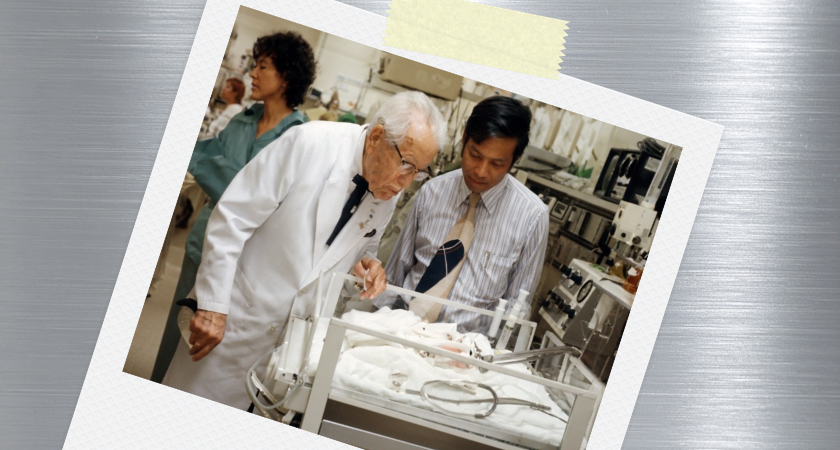
The photo on our fridge that explains everything I know about purpose at work
What do people really need? When we need answers to this question we often turn to Maslow’s Hierarchy of Needs. Right up the top of that ladder, we find: “Self Actualisation”. This is often described as the need to realise one’s full potential. In many ways I’ve always thought of this as a pursuit not of happiness but meaning.
From a work perspective this is about not just working for money, and not just doing a job you like, but doing work that fulfills some transcendent need.
When I was growing up there was a picture of my father on the fridge at home. Pa was a Neonatologist who looked after and cared for premature babies. The picture shows Pa in a hospital in Denver (Colorado), showing around none other than Colonel Sanders – the “father” of Kentucky Fried Chicken. It is an image that comes to mind whenever I think about the purpose of his work, the lives he saved, and the reason why he worked the incredible hours he did. This made purpose tangible for me at a young age. I mean, if the Colonel thought Neonatology was important it must be: right?
I didn’t follow the career path my parents hoped I would. Like many migrant families, they held up medicine, law and engineering as the obvious choices. These were the professions with clear societal value. My younger brother recently reflected on this idea of the world being “your oyster”, so long as inside that oyster you found a career in medicine, engineering or law.
Not having chosen the oyster path, I think, made purpose even more important to me in my own work. But companies and professions don’t have to save the world to have a purpose that matters. In fact, if you’re not saving the world, purpose may be an even more important find.
One of the reasons I loved working at BP was its stated purpose of providing heat, light and mobility. Simple. Practical. Immensely important. Everyone I worked with seemed aligned to it. You could connect to your individual role, no matter how removed, to something that genuinely mattered. That creates belief. And belief changes how people show up.
That’s why I’m drawn to working with organisations today that are clear about why they exist, and honest about it. One of the organisations that we’re privileged to work with is Neumann Space. Their mission is to help make space sustainable. It may seem strange, but space is getting crowded. Yet, Neumann’s unique technology propels satellites using metal as the fuel. Their ultimate ambition? To turn space debris into fuel. Cleaning up orbital junk while enabling future exploration? That’s a purpose you don’t need to oversell.
From an employee value proposition perspective, the concept of purpose matters deeply. People don’t always just choose professions, they choose who they work for. Purpose gives meaning to effort, resilience during tough periods, and pride in representation. It also acts as a filter. The right people flourish while misalignment of purpose surfaces early.
It is sometimes difficult to really be clear about what your purpose as a company is. It’s not because coming up with the words is difficult, but because often different people within an organisation have a different view. In our experience you have to look at multiple factors, from strategy to culture to get it right.
If you don’t, or if purpose is vague or manufactured, employees disengage, or worse they distrust it, opt out and move on.
Purpose, done well, on the other hand shows up in decisions, behaviours and trade‑offs.
It’s lived.
It’s finger lickin’ good.
Author: Chandran Vigneswaran